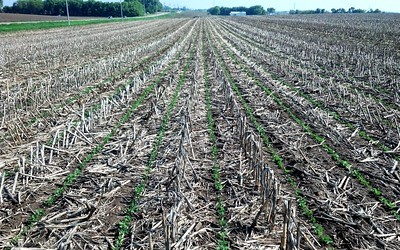
Tyler Duerst farms cropland in the Sugar River watershed and also works with his in-laws on their medium-sized dairy farm in Darlington, Wisconsin. On his grain acres, Tyler grows corn, soybeans, and wheat. He uses no-till practices and plants cover crops after wheat harvest.
Some of the land Tyler now farms was once part of his family’s original home farm. To help preserve the land and keep it in agriculture, his family chose to sell a significant portion of the property to Dane County rather than to developers. As a result, the land will remain open space, including areas that will continue to be farmed.
Tyler is especially interested in how cover crops can help dry out some of his low, wet acres in the spring, while also improving soil health and nutrient cycling.
Tyler’s dad, Tom, and his uncle, Mike, operated the farm that is now part of Dane County’s Sugar River Wildlife Area. What began as a dairy farm eventually transitioned into a grain operation. Along the way, the brothers focused on reducing soil loss on the farm’s hills by adopting no-till management. They also experimented with cover crops, but with the amount of residue they were able to maintain through no-till, they did not see as much need for them at the time.
As the brothers approached retirement, and with their children pursuing careers elsewhere, they decided to sell much of the land they had farmed together and begin the next chapter of retirement.
When the land became available to rent, Tyler pursued the opportunity to grow his own grain operation. Although he is based in Darlington, Tyler is able to manage cropland in Verona—about 45 minutes away—with occasional help from his dad and uncle.
Tyler worked with his in-laws in Darlington and their agronomist to transition the dairy farm to no-till. The change not only brought environmental benefits, but also reduced fuel use and labor needs on the farm.
As Tyler expanded his own grain farming operation, he chose to use no-till as well and has been exploring ways to incorporate cover crops. Farming requires equipment, and tillage equipment is not something Tyler owns. His dad and uncle have kept an older disc, which he uses on wet fields in the spring. He is now interested in either upgrading that tillage equipment or finding a way to use cover crops to accomplish the same goal as tillage: helping dry out low, wet fields in the spring.
That interest led Tyler to pursue a project comparing tillage, no-till, and no-till with cover crops at different seeding rates. Stay tuned for more on the project’s findings.
Switching to no-till has brought many benefits. In Tyler’s experience, the transition led to a very minor drop in yield during the first couple of years, but yields rebounded. The time savings have been a clear advantage. As with many farming operations, several field tasks often need to happen at the same time, so removing tillage from the to-do list has saved significant time.
If cover crops can replace tillage on the low, wet fields, that could provide even more benefits. Time will tell how well that works for his operation.
Be patient, it's going to take a couple years to get the ground ready to be in a no-till program, it does come around.
Transitioning to No-Till with Tyler Duerst (Dane Demo Farm Podcast)